What Do You Know About God Meme
A meme ( MEEM )[1] [2] [iii] is an idea, beliefs, or way that spreads past means of imitation from person to person within a culture and often carries symbolic meaning representing a detail phenomenon or theme.[4] A meme acts as a unit for carrying cultural ideas, symbols, or practices, that tin exist transmitted from one mind to another through writing, speech, gestures, rituals, or other imitable phenomena with a mimicked theme. Supporters of the concept regard memes as cultural analogues to genes in that they self-replicate, mutate, and answer to selective pressures.[five]
Proponents theorize that memes are a viral phenomenon that may evolve past natural selection in a style analogous to that of biological evolution.[6] Memes do this through the processes of variation, mutation, competition, and inheritance, each of which influences a meme'south reproductive success. Memes spread through the behavior that they generate in their hosts. Memes that propagate less prolifically may become extinct, while others may survive, spread, and (for better or for worse) mutate. Memes that replicate near finer enjoy more success, and some may replicate effectively even when they prove to exist detrimental to the welfare of their hosts.[7]
A field of written report called memetics [8] arose in the 1990s to explore the concepts and manual of memes in terms of an evolutionary model. Criticism from a diverseness of fronts has challenged the notion that academic study tin examine memes empirically. All the same, developments in neuroimaging may make empirical study possible.[9] Some commentators in the social sciences question the idea that one tin can meaningfully categorize culture in terms of discrete units, and are especially critical of the biological nature of the theory's underpinnings.[10] Others take argued that this use of the term is the result of a misunderstanding of the original proposal.[xi]
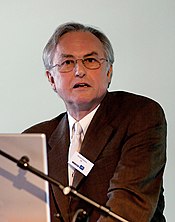
The word meme itself is a neologism coined past Richard Dawkins, originating from his 1976 volume The Selfish Factor.[12] Dawkins's own position is somewhat ambiguous. He welcomed N. M. Humphrey'southward proposition that "memes should be considered every bit living structures, non just metaphorically"[12] and proposed to regard memes as "physically residing in the brain."[13] Although Dawkins said his original intentions had been simpler, he approved Humphrey's opinion and he endorsed Susan Blackmore's 1999 project to requite a scientific theory of memes, complete with predictions and empirical support.[14]
Etymology
The term meme is a shortening (modeled on gene) of mimeme, which comes from Ancient Greek mīmēma ( μίμημα ; pronounced [míːmɛːma]), meaning 'imitated matter', itself from mimeisthai ( μιμεῖσθαι , 'to imitate'), from mimos ( μῖμος , 'mime').[xv] [16] [17]
The word was coined by British evolutionary biologist Richard Dawkins in The Selfish Gene (1976) as a concept for give-and-take of evolutionary principles in explaining the spread of ideas and cultural phenomena.[12] [eighteen] Examples of memes given in Dawkins' book include melodies, catchphrases, way, and the applied science of building arches.[19] The word 'meme' is autological in nature, meaning information technology'due south a word that describes itself; in other words, the give-and-take 'meme' is itself a meme.[ citation needed ]
Origins
Early formulations
Although Richard Dawkins invented the term meme and developed meme theory, he has not claimed that the thought was entirely novel,[twenty] and there have been other expressions for similar ideas in the past.[21]
For instance, the possibility that ideas were subject field to the aforementioned pressures of development as were biological attributes was discussed in the time of Charles Darwin. T. H. Huxley (1880) claimed that "The struggle for existence holds as much in the intellectual as in the concrete world. A theory is a species of thinking, and its right to exist is coextensive with its power of resisting extinction by its rivals."[22]
In 1904, Richard Semon published Die Mneme (which appeared in English language in 1924 every bit The Mneme). The term mneme was likewise used in Maurice Maeterlinck'south The Life of the White Ant (1926), with some parallels to Dawkins's concept.[21] Kenneth State highway had, in 1954, coined the related terms emic and etic, generalizing the linguistic units of phoneme, morpheme, grapheme, lexeme, and tagmeme (as ready out by Leonard Bloomfield), distinguishing insider and outside views of chatty behavior.[23]
Dawkins
The discussion meme originated with Richard Dawkins' 1976 book The Selfish Factor.
Dawkins cites as inspiration the work of geneticist L. L. Cavalli-Sforza, anthropologist F. T. Cloak,[24] [25] and ethologist J. Thou. Cullen.[26] Dawkins wrote that development depended not on the particular chemical basis of genetics, but only on the being of a self-replicating unit of measurement of transmission—in the example of biological evolution, the gene. For Dawkins, the meme exemplified another self-replicating unit with potential significance in explaining human behavior and cultural evolution.

"Kilroy was here" was a graffito that became popular in the 1940s, and existed under various names in different countries, illustrating how a meme can be modified through replication. This is seen every bit ane of the kickoff widespread memes in the world[27]
Dawkins used the term to refer to any cultural entity that an observer might consider a replicator. He hypothesized that one could view many cultural entities as replicators, and pointed to melodies, fashions and learned skills equally examples. Memes generally replicate through exposure to humans, who have evolved every bit efficient copiers of information and behavior. Because humans do not always copy memes perfectly, and because they may refine, combine or otherwise modify them with other memes to create new memes, they can alter over time. Dawkins likened the process past which memes survive and change through the evolution of civilization to the natural selection of genes in biological evolution.[19]
Dawkins defined the meme as a unit of cultural transmission, or a unit of simulated and replication, but subsequently definitions would vary. The lack of a consequent, rigorous, and precise agreement of what typically makes upwardly one unit of cultural transmission remains a problem in debates near memetics.[28] In contrast, the concept of genetics gained concrete evidence with the discovery of the biological functions of DNA. Meme manual requires a concrete medium, such as photons, sound waves, touch on, taste, or smell because memes tin can be transmitted simply through the senses.
Dawkins noted that in a society with civilization a person need non have descendants to remain influential in the actions of individuals thousands of years afterwards their death:
But if you contribute to the world'due south civilisation, if you have a skilful idea...it may live on, intact, long later on your genes have dissolved in the common pool. Socrates may or may not accept a gene or two alive in the globe today, equally Yard.C. Williams has remarked, but who cares? The meme-complexes of Socrates, Leonardo, Copernicus and Marconi are all the same going potent.[half-dozen]
Memetic lifecycle: transmission, retention

Memes, analogously to genes, vary in their aptitude to replicate; successful memes remain and spread, whereas unfit ones stall and are forgotten. Thus, memes that testify more effective at replicating and surviving are selected in the meme puddle.
Memes start need retention. The longer a meme stays in its hosts, the higher its chances of propagation are. When a host uses a meme, the meme'southward life is extended.[29] The reuse of the neural space hosting a certain meme'southward copy to host unlike memes is the greatest threat to that meme'due south re-create.[xxx] A meme that increases the longevity of its hosts volition generally survive longer. On the reverse, a meme that shortens the longevity of its hosts will tend to disappear faster. However, equally hosts are mortal, retention is non sufficient to perpetuate a meme in the long term; memes likewise need transmission.
Life-forms tin can transmit information both vertically (from parent to child, via replication of genes) and horizontally (through viruses and other ways). Memes can replicate vertically or horizontally within a unmarried biological generation. They may also lie dormant for long periods of time.
Memes reproduce by copying from a nervous system to some other 1, either by communication or fake. Faux often involves the copying of an observed beliefs of another private. Communication may exist straight or indirect, where memes transmit from one individual to another through a copy recorded in an inanimate source, such as a volume or a musical score. Adam McNamara has suggested that memes can be thereby classified as either internal or external memes (i-memes or e-memes).[ix]
Some commentators have likened the transmission of memes to the spread of contagions.[31] Social contagions such as fads, hysteria, copycat crime, and copycat suicide exemplify memes seen as the contagious imitation of ideas. Observers distinguish the contagious imitation of memes from instinctively contagious phenomena such every bit yawning and laughing, which they consider innate (rather than socially learned) behaviors.[32]
Aaron Lynch described vii general patterns of meme transmission, or "thought contamination":[33]
- Quantity of parenthood: an thought that influences the number of children one has. Children answer particularly receptively to the ideas of their parents, and thus ideas that directly or indirectly encourage a college nascence charge per unit will replicate themselves at a higher rate than those that discourage higher birth rates.
- Efficiency of parenthood: an idea that increases the proportion of children who will adopt ideas of their parents. Cultural separatism exemplifies 1 practise in which i can await a higher rate of meme-replication—because the meme for separation creates a barrier from exposure to competing ideas.
- Proselytic: ideas mostly passed to others beyond one'south own children. Ideas that encourage the proselytism of a meme, as seen in many religious or political movements, tin replicate memes horizontally through a given generation, spreading more quickly than parent-to-kid meme-transmissions do.
- Preservational: ideas that influence those that hold them to go along to hold them for a long time. Ideas that encourage longevity in their hosts, or leave their hosts specially resistant to abandoning or replacing these ideas, enhance the preservability of memes and afford protection from the contest or proselytism of other memes.
- Adversative: ideas that influence those that hold them to assault or sabotage competing ideas and/or those that concur them. Adversative replication can requite an reward in meme transmission when the meme itself encourages aggression against other memes.
- Cerebral: ideas perceived equally cogent past most in the population who run into them. Cognitively transmitted memes depend heavily on a cluster of other ideas and cognitive traits already widely held in the population, and thus usually spread more passively than other forms of meme manual. Memes spread in cognitive manual do non count as self-replicating.
- Motivational: ideas that people adopt because they perceive some self-interest in adopting them. Strictly speaking, motivationally transmitted memes do not self-propagate, but this manner of manual often occurs in association with memes self-replicated in the efficiency parental, proselytic and preservational modes.
Memes equally discrete units
Dawkins initially defined meme as a noun that "conveys the idea of a unit of cultural transmission, or a unit of imitation."[xix] John South. Wilkins retained the notion of meme as a kernel of cultural false while emphasizing the meme's evolutionary aspect, defining the meme every bit "the least unit of sociocultural data relative to a selection process that has favorable or unfavorable option bias that exceeds its endogenous tendency to change."[34] The meme as a unit provides a convenient means of discussing "a piece of thought copied from person to person," regardless of whether that thought contains others inside it, or forms part of a larger meme. A meme could consist of a single discussion, or a meme could consist of the entire oral communication in which that give-and-take commencement occurred. This forms an analogy to the idea of a gene every bit a unmarried unit of self-replicating information establish on the cocky-replicating chromosome.
While the identification of memes as "units" conveys their nature to replicate as discrete, indivisible entities, it does not imply that thoughts somehow become quantized or that "atomic" ideas be that cannot be dissected into smaller pieces. A meme has no given size. Susan Blackmore writes that melodies from Beethoven's symphonies are commonly used to illustrate the difficulty involved in delimiting memes as discrete units. She notes that while the starting time four notes of Beethoven'due south Fifth Symphony (  listen(help·info) ) course a meme widely replicated as an independent unit, one tin can regard the unabridged symphony every bit a single meme as well.[28]
The inability to pin an idea or cultural feature to quantifiable fundamental units is widely acknowledged as a problem for memetics. It has been argued nevertheless that the traces of memetic processing can be quantified utilizing neuroimaging techniques which measure changes in the connectivity profiles between brain regions."[ix] Blackmore meets such criticism by stating that memes compare with genes in this respect: that while a factor has no particular size, nor can nosotros ascribe every phenotypic characteristic straight to a particular factor, it has value because it encapsulates that key unit of measurement of inherited expression subject to evolutionary pressures. To illustrate, she notes evolution selects for the gene for features such as center color; information technology does non select for the individual nucleotide in a strand of DNA. Memes play a comparable role in understanding the development of imitated behaviors.[28]
Genes, Heed, and Culture: The Coevolutionary Process (1981) by Charles J. Lumsden and E. O. Wilson proposes the theory that genes and civilisation co-evolve, and that the primal biological units of culture must stand for to neuronal networks that function as nodes of semantic retentivity. Lumsden and Wilson coined their own discussion, culturgen, which did not catch on. Coauthor Wilson later acknowledged the term meme as the best label for the key unit of cultural inheritance in his 1998 book Consilience: The Unity of Knowledge, which elaborates upon the fundamental part of memes in unifying the natural and social sciences.[35]
Evolutionary influences on memes
Dawkins noted the 3 conditions that must exist for evolution to occur:[36]
- variation, or the introduction of new change to existing elements;
- heredity or replication, or the chapters to create copies of elements;
- differential "fitness", or the opportunity for one element to exist more or less suited to the environment than some other.
Dawkins emphasizes that the procedure of development naturally occurs whenever these conditions co-exist, and that evolution does not utilise only to organic elements such every bit genes. He regards memes as likewise having the properties necessary for evolution, and thus sees meme development as not simply analogous to genetic development, only every bit a real phenomenon discipline to the laws of natural choice. Dawkins noted that as various ideas pass from one generation to the side by side, they may either enhance or detract from the survival of the people who obtain those ideas, or influence the survival of the ideas themselves. For example, a certain civilization may develop unique designs and methods of tool-making that give it a competitive advantage over another culture. Each tool-design thus acts somewhat similarly to a biological factor in that some populations accept it and others do not, and the meme'south role direct affects the presence of the design in futurity generations. In keeping with the thesis that in development one tin can regard organisms simply equally suitable "hosts" for reproducing genes, Dawkins argues that one can view people every bit "hosts" for replicating memes. Consequently, a successful meme may or may not need to provide any benefit to its host.[36]
Unlike genetic evolution, memetic evolution can show both Darwinian and Lamarckian traits. Cultural memes will have the characteristic of Lamarckian inheritance when a host aspires to replicate the given meme through inference rather than by exactly copying it. Take for instance the case of the transmission of a elementary skill such as hammering a smash, a skill that a learner imitates from watching a demonstration without necessarily imitating every discrete motility modeled by the instructor in the demonstration, stroke for stroke.[37] Susan Blackmore distinguishes the difference between the two modes of inheritance in the evolution of memes, characterizing the Darwinian mode as "copying the instructions" and the Lamarckian as "copying the product."[28]
Clusters of memes, or memeplexes (as well known as meme complexes or as memecomplexes), such as cultural or political doctrines and systems, may besides play a office in the credence of new memes. Memeplexes incorporate groups of memes that replicate together and coadapt.[28] Memes that fit inside a successful memeplex may gain acceptance by "piggybacking" on the success of the memeplex. Equally an case, John D. Gottsch discusses the manual, mutation and selection of religious memeplexes and the theistic memes contained.[38] Theistic memes discussed include the "prohibition of abnormal sexual practices such equally incest, infidelity, homosexuality, bestiality, castration, and religious prostitution", which may accept increased vertical transmission of the parent religious memeplex. Like memes are thereby included in the bulk of religious memeplexes, and harden over time; they become an "inviolable canon" or ready of dogmas, eventually finding their way into secular law. This could too be referred to equally the propagation of a taboo.
Memetics
The discipline of memetics, which dates from the mid-1980s, provides an arroyo to evolutionary models of cultural data transfer based on the concept of the meme. Memeticists have proposed that merely as memes part analogously to genes, memetics functions analogously to genetics. Memetics attempts to apply conventional scientific methods (such as those used in population genetics and epidemiology) to explain existing patterns and manual of cultural ideas.
Chief criticisms of memetics include the claim that memetics ignores established advances in other fields of cultural study, such as sociology, cultural anthropology, cognitive psychology, and social psychology. Questions remain whether or not the meme concept counts as a validly disprovable scientific theory. This view regards memetics every bit a theory in its infancy: a protoscience to proponents, or a pseudoscience to some detractors.
Criticism of meme theory
![[icon]](https://upload.wikimedia.org/wikipedia/commons/thumb/1/1c/Wiki_letter_w_cropped.svg/20px-Wiki_letter_w_cropped.svg.png) | This section needs expansion. You tin can assistance by adding to information technology. (February 2021) |
An objection to the study of the evolution of memes in genetic terms (although not to the existence of memes) involves a perceived gap in the gene/meme illustration: the cumulative evolution of genes depends on biological selection-pressures neither also bully nor too small in relation to mutation-rates. There seems no reason to think that the same balance volition exist in the selection pressures on memes.[39]
Luis Benitez-Bribiesca M.D., a critic of memetics, calls the theory a "pseudoscientific dogma" and "a dangerous thought that poses a threat to the serious study of consciousness and cultural development". Every bit a factual criticism, Benitez-Bribiesca points to the lack of a "code script" for memes (analogous to the Deoxyribonucleic acid of genes), and to the excessive instability of the meme mutation mechanism (that of an thought going from one brain to another), which would lead to a low replication accuracy and a loftier mutation rate, rendering the evolutionary process chaotic.[40] In his volume Darwin's Unsafe Idea Daniel C. Dennett rebuts this claim, pointing to the existence of self-regulating correction mechanisms (vaguely resembling those of gene transcription) enabled past the back-up and other properties of virtually meme expression languages which stabilize information transfer.[41] Dennett notes that spiritual narratives, including music and trip the light fantastic toe forms, can survive in full detail across any number of generations even in cultures with oral tradition only. Memes for which stable copying methods are bachelor will inevitably go selected for survival more often than those which can only have unstable mutations, therefore going extinct.
British political philosopher John Greyness has characterized Dawkins's memetic theory of religion as "nonsense" and "non fifty-fifty a theory... the latest in a succession of ill-judged Darwinian metaphors", comparable to Intelligent Design in its value equally a science.[42]
Some other critique comes from semiotic theorists such as Terrence Deacon[43] and Kalevi Kull.[44] This view regards the concept of "meme" as a primitivized concept of "sign". The meme is thus described in memetics every bit a sign lacking a triadic nature. Semioticians can regard a meme as a "degenerate" sign, which includes only its ability of existence copied. Accordingly, in the broadest sense, the objects of copying are memes, whereas the objects of translation and estimation are signs.[ clarification needed ]
Fracchia and Lewontin regard memetics as reductionist and inadequate.[45] Evolutionary biologist Ernst Mayr disapproved of Dawkins's gene-based view and usage of the term "meme", asserting it to be an "unnecessary synonym" for "concept", reasoning that concepts are not restricted to an individual or a generation, may persist for long periods of time, and may evolve.[46]
Radim Chvaja, a researcher for Masaryk University states that Memetic theory has failed due to the idea's founders Richard Dawkins and George C. Williams taking on a "strict adoption" of their argument which in turn forced them to dig in to the idea that the replication of a meme is biological in nature.[47]
Elliott Oring calls Dawkins' term "the selfish gene" potentially "dangerous and misleading". Co-ordinate to Oring, Dawkins suggests that genes aren't already selfish in the sense that they will practice whatever it takes to survive and replicate as it is. Memes as Dawkins describes them exercise not conduct that way, according to Oring. They do not have strict generational lines, and they do not exercise whatever information technology takes to assure their own survival, since memes are not alive. Oring goes on to say that memes are dissimilar from genes in the sense that they do non particularly need to keep their individual biological hosts live, every bit they exercise not rely on any type of genetic lawmaking to replicate and reproduce. Oring suggests that the problem with memes as a whole is that they cannot exist "precisely specified".[48]
Applications
Opinions differ as to how best to utilize the concept of memes within a "proper" disciplinary framework. One view sees memes equally providing a useful philosophical perspective with which to examine cultural evolution. Proponents of this view (such as Susan Blackmore and Daniel Dennett) debate that because cultural developments from a meme's-eye view—equally if memes themselves respond to pressure to maximise their own replication and survival—can pb to useful insights and yield valuable predictions into how civilization develops over time. Others such as Bruce Edmonds and Robert Aunger have focused on the demand to provide an empirical grounding for memetics to go a useful and respected scientific subject field.[49] [50]
A tertiary arroyo, described past Joseph Poulshock, as "radical memetics" seeks to identify memes at the centre of a materialistic theory of mind and of personal identity.[51]
Prominent researchers in evolutionary psychology and anthropology, including Scott Atran, Dan Sperber, Pascal Boyer, John Tooby and others, contend the possibility of incompatibility betwixt modularity of listen and memetics.[ citation needed ] In their view, minds structure certain communicable aspects of the ideas produced, and these communicable aspects more often than not trigger or elicit ideas in other minds through inference (to relatively rich structures generated from frequently low-fidelity input) and not high-fidelity replication or imitation. Atran discusses communication involving religious beliefs equally a instance in bespeak. In one set of experiments he asked religious people to write downwards on a piece of paper the meanings of the 10 Commandments. Despite the subjects' own expectations of consensus, interpretations of the commandments showed broad ranges of variation, with niggling evidence of consensus. In another experiment, subjects with autism and subjects without autism interpreted ideological and religious sayings (for example, "Let a grand flowers flower" or "To everything there is a season"). People with autism showed a significant tendency to closely paraphrase and repeat content from the original statement (for case: "Don't cut flowers earlier they bloom"). Controls tended to infer a wider range of cultural meanings with footling replicated content (for example: "Go with the flow" or "Everyone should take equal opportunity"). Only the subjects with autism—who lack the degree of inferential capacity ordinarily associated with aspects of theory of heed—came close to functioning every bit "meme machines."[52]
In his book The Robot's Rebellion, Keith Stanovich uses the memes and memeplex concepts to draw a plan of cognitive reform that he refers to equally a "rebellion." Specifically, Stanovich argues that the use of memes as a descriptor for cultural units is beneficial considering it serves to emphasize transmission and acquisition backdrop that parallel the study of epidemiology. These backdrop make salient the sometimes parasitic nature of acquired memes, and as a result individuals should exist motivated to reflectively acquire memes using what he calls a "Neurathian bootstrap" process.[53]
Memetic explanations of racism
In Cultural Software: A Theory of Ideology, Jack Balkin argued that memetic processes can explain many of the most familiar features of ideological idea. His theory of "cultural software" maintained that memes form narratives, social networks, metaphoric and metonymic models, and a variety of different mental structures. Balkin maintains that the same structures used to generate ideas near free spoken language or costless markets also serve to generate racistic beliefs. To Balkin, whether memes become harmful or maladaptive depends on the environmental context in which they exist rather than in whatever special source or manner to their origination. Balkin describes racist beliefs as "fantasy" memes that become harmful or unjust "ideologies" when diverse peoples come together, as through merchandise or competition.[54]
Religion
Richard Dawkins called for a re-assay of religion in terms of the evolution of self-replicating ideas apart from any resulting biological advantages they might bestow.
As an enthusiastic Darwinian, I have been dissatisfied with explanations that my fellow-enthusiasts have offered for human behaviour. They have tried to look for 'biological advantages' in various attributes of human culture. For instance, tribal organized religion has been seen as a machinery for solidifying grouping identity, valuable for a pack-hunting species whose individuals rely on cooperation to catch large and fast prey. Often the evolutionary preconception in terms of which such theories are framed is implicitly group-selectionist, merely it is possible to rephrase the theories in terms of orthodox gene selection.
He argued that the office of key replicator in cultural evolution belongs not to genes, but to memes replicating idea from person to person past ways of simulated. These replicators respond to selective pressures that may or may not affect biological reproduction or survival.[19]
In her volume The Meme Machine, Susan Blackmore regards religions equally particularly tenacious memes. Many of the features common to the most widely practiced religions provide congenital-in advantages in an evolutionary context, she writes. For case, religions that preach of the value of faith over evidence from everyday experience or reason inoculate societies against many of the most bones tools people commonly use to evaluate their ideas. By linking altruism with religious affiliation, religious memes can proliferate more quickly because people perceive that they can reap societal as well as personal rewards. The longevity of religious memes improves with their documentation in revered religious texts.[28]
Aaron Lynch attributed the robustness of religious memes in human culture to the fact that such memes comprise multiple modes of meme transmission. Religious memes pass down the generations from parent to kid and across a single generation through the meme-substitution of proselytism. Near people volition agree the religion taught them by their parents throughout their life. Many religions feature adversarial elements, punishing apostasy, for instance, or demonizing infidels. In Thought Contagion Lynch identifies the memes of manual in Christianity as particularly powerful in scope. Believers view the conversion of non-believers both every bit a religious duty and as an human action of altruism. The promise of sky to believers and threat of hell to non-believers provide a potent incentive for members to retain their belief. Lynch asserts that belief in the Crucifixion of Jesus in Christianity amplifies each of its other replication advantages through the indebtedness believers accept to their Savior for sacrifice on the cross. The image of the crucifixion recurs in religious sacraments, and the proliferation of symbols of the cross in homes and churches potently reinforces the wide assortment of Christian memes.[33]
Although religious memes take proliferated in human cultures, the mod scientific customs has been relatively resistant to religious belief. Robertson (2007)[55] reasoned that if development is accelerated in conditions of propagative difficulty,[41] then we would expect to encounter variations of religious memes, established in general populations, addressed to scientific communities. Using a memetic approach, Robertson deconstructed two attempts to privilege religiously held spirituality in scientific discourse. Advantages of a memetic approach as compared to more traditional "modernization" and "supply side" theses in agreement the evolution and propagation of religion were explored.
Architectural memes
In A Theory of Architecture, Nikos Salingaros speaks of memes every bit "freely propagating clusters of information" which can be beneficial or harmful. He contrasts memes to patterns and true cognition, characterizing memes as "greatly simplified versions of patterns" and every bit "unreasoned matching to some visual or mnemonic prototype."[56] Taking reference to Dawkins, Salingaros emphasizes that they can be transmitted due to their own chatty backdrop, that "the simpler they are, the faster they tin can proliferate," and that the nearly successful memes "come with a great psychological appeal."[57]
Architectural memes, according to Salingaros, can take destructive power: "Images portrayed in architectural magazines representing buildings that could not possibly suit everyday uses get fixed in our memory, so we reproduce them unconsciously."[58] He lists various architectural memes that circulated since the 1920s and which, in his view, have led to contemporary architecture condign quite decoupled from human needs. They lack connection and meaning, thereby preventing "the creation of true connections necessary to our understanding of the world." He sees them as no different from antipatterns in software design—equally solutions that are false but are re-utilized nonetheless.[59]
Internet culture
An "Internet meme" is a concept that spreads chop-chop from person to person via the Internet.[sixty] typically as a form of sense of humor.
In 2013, Richard Dawkins characterized an Internet meme as 1 deliberately contradistinct by human creativity, distinguished from his original thought involving mutation "past random change and a form of Darwinian selection."[61]
Net memes have been effectually since the showtime of the internet itself, just were made massively popular when social media sites and message boards offset began popping up. Typically, memes have been based on a certain format such as the 'Grumpy True cat' or 'Bad-Luck Brian' memes that were popular in the early 2010's. the creator of the meme conveys a message through said format. Net memes have get one of the chief forms of digital advice in the past two decades. They are used by everyday people for purposes of cocky-expression, they are used by businesses for advertizement purposes, by political groups to make points or convey letters to their followers, for comedic purposes and even for religious reasons.
Cyberspace memes are an example of Dawkins' meme theory at work in the sense of how they so chop-chop mirror current cultural events and become a part of how the time period is divers. Limor Shifman uses the example of the 'Gangnam Way' Music video by South Korean pop-star, Psy that went viral in 2012. Shifman cites examples of how the meme mutated itself into the cultural sphere, mixing with other things going on at the time such as the 2012 U.Southward. presidential election, which led to the creation of Manus Romney Fashion, a parody of the original Gangnam mode, intended to be a jab at the 2012 Republican presidential candidate, Mitt Romney.[62] [63] [64]
Meme stocks
Meme stocks, a particular subset of Internet memes in general, are listed companies lauded for the social media buzz they create, rather than their operating performance.[65] r/wallstreetbets, a subreddit where participants discuss stock and option trading, and the financial services company Robinhood Markets, became notable in 2021 for their interest on the popularization and enhancement of meme stocks.[66] [67]
Run across also
- Baldwin upshot
- The Beginning of Infinity
- Biosemiotics
- Chain letter
- Darwin machine
- Dual inheritance theory
- Evolutionary biological science
- Framing (social sciences)
- Internet meme
- Leiden school
- Memetic algorithm
- Memetic engineering
- Phraseme
- Propaganda
- Psycholinguistics
- Snowclone
- Survivals
- Universal Darwinism
- Viral marketing
- Viral video
Notes
- ^ "meme". Oxford Dictionaries. Archived from the original on 2019-05-23. Retrieved 2017-12-30 .
- ^ "meme Significant in the Cambridge English Dictionary". Cambridge Lexicon.
- ^ "meme noun". Oxford Learner'due south Dictionaries. Archived from the original on 2019-05-20. Retrieved 2017-12-30 .
- ^ Meme. Merriam-Webster Lexicon.
- ^ Graham 2002
- ^ a b Dawkins, Richard (2006). The Selfish Gene 30th Anniversary Edition (3rd ed.). Oxford University Press. p. 199. ISBN9780191537554.
- ^ Kelly 1994, p. 360 "Simply if we consider culture as its own self-organizing organisation—a organisation with its ain agenda and force per unit area to survive—and then the history of humanity gets fifty-fifty more interesting. As Richard Dawkins has shown, systems of self-replicating ideas or memes tin can quickly accrue their ain agenda and behaviours. I assign no higher motive to a cultural entity than the archaic bulldoze to reproduce itself and alter its environs to assist its spread. One way the cocky organizing organisation can practice this is by consuming human biological resources."
- ^ Heylighen & Chielens 2009
- ^ a b c McNamara 2011
- ^ Gill, Jameson. 2011. "Memes and narrative analysis: A potential management for the evolution of neo-Darwinian orientated research in organisations." EURAM eleven: Proceedings of the European University of Management. European Academy of Management. ISSN 2466-7498. S2CID 54894144.
- ^ Burman, J. T. (2012). "The misunderstanding of memes: Biography of an unscientific object, 1976–1999". Perspectives on Science. 20 (1): 75–104. doi:10.1162/POSC_a_00057.
- ^ a b c Dawkins 1989, p. 192 "We need a name for the new replicator, a noun that conveys the idea of a unit of cultural manual, or a unit of imitation. 'Mimeme' comes from a suitable Greek root, only I want a monosyllable that sounds a bit like 'gene'. I hope my classicist friends will forgive me if I abbreviate mimeme to meme. If information technology is whatsoever consolation, it could alternatively be thought of as being related to 'memory', or to the French word même. It should be pronounced to rhyme with 'cream'."
- ^ Dawkins, Richard (1982), The Extended Phenotype, Oxford Academy Press, p. 109, ISBN978-0-xix-286088-0
- ^ Dawkins'south foreword to Blackmore 1999, p. xvi-xvii
- ^ The American Heritage Lexicon of the English language: Fourth Edition, 2000
- ^ Harper, Douglas. "meme". Online Etymology Dictionary.
- ^ μίμημα , μιμεῖσθαι , μῖμος . Liddell, Henry George; Scott, Robert; A Greek–English Lexicon at the Perseus Projection.
- ^ Millikan 2004, p. 16. "Richard Dawkins invented the term 'memes' to stand for items that are reproduced by faux rather than reproduced genetically."
- ^ a b c d Dawkins 1989, p. 352
- ^ Shalizi, Cosma Rohilla. "Memes". Center for the Study of Complex Systems. Academy of Michigan. Archived from the original on 2012-06-eleven. Retrieved 2021-10-08 .
- ^ a b Laurent, John (1999). "A Notation on the Origin of 'Memes'/'Mnemes'". Journal of Memetics. 3 (1): 14–19. Archived from the original on 2021-04-13.
- ^ Huxley, T. H. (1880). "The coming of historic period of 'The origin of species'". Scientific discipline. 1 (2): fifteen–20. doi:10.1126/scientific discipline.os-one.2.15. PMID 17751948.
- ^ Kenneth Pike, Language in Relation to a Unified Theory of the Structure of Human Behavior (1954, revised 1967)
- ^ Cloak, F. T. 1966. "Cultural microevolution." Research Previews 13(2):7–ten. (Also presented at the November, 1966 almanac meeting of the American Anthropological Association.)
- ^ Cloak, F. T. 1975. "Is a cultural ethology possible?" Human Ecology 3:161–82. doi:ten.1007/BF01531639.
- ^ "The Selfish Factor: Chapter 11 - Summary & Assay." LitCharts.
- ^ Gardner, Martin (5 March 2000). "Kilroy Was Here". Los Angeles Times . Retrieved 2021-10-08 .
- ^ a b c d e f Blackmore 1999
- ^ Heylighen, Francis. "Meme replication: the memetic life-bike". Principia Cybernetica . Retrieved 2013-07-26 .
- ^ R. Evers, John. "A justification of societal altruism according to the memetic awarding of Hamilton's rule". Retrieved 2013-07-26 .
- ^ Blackmore 1998; "The term 'contamination' is oft associated with memetics. We may say that certain memes are contagious, or more contagious than others."
- ^ Blackmore 1998
- ^ a b Lynch 1996
- ^ Wilkins, John S. (1998). "What's in a Meme? Reflections from the perspective of the history and philosophy of evolutionary biology". Journal of Memetics. two. Archived from the original on 2009-12-01. Retrieved 2008-12-xiii .
- ^ Wilson 1998
- ^ a b Dennett 1991
- ^ Dawkins 2004
- ^ Gottsch, John D. (2001). "Mutation, Selection, And Vertical Transmission Of Theistic Memes In Religious Canons". Journal of Memetics. v (1). Archived from the original on 2021-04-12. Retrieved 2021-x-08 .
- ^ Sterelny & Griffiths 1999; p. 333
- ^ Benitez Bribiesca, Luis (January 2001), "Memetics: A dangerous idea" (PDF), Interciencia: Revista de Ciencia y Technologia de América, 26 (1): 29–31, ISSN 0378-1844, retrieved 2010-02-11 ,
If the mutation rate is high and takes identify over short periods, as memetics predict, instead of selection, adaptation and survival a chaotic disintegration occurs due to the accumulation of errors.
- ^ a b Dennett, Daniel C. (1995), Darwin's Unsafe Idea: Evolution and the meanings of life, New York: Simon and Schuster
- ^ Gray, John (14 March 2008). "The atheist delusion". The Guardian.
- ^ Deacon, Terrence. "The trouble with memes (and what to practice about it)". The Semiotic Review of Books. ten: three.
- ^ Kull, Kalevi (2000). "Re-create versus translate, meme versus sign: development of biological textuality". European Journal for Semiotic Studies. 12 (1): 101–120.
- ^ Fracchia, Joseph; R C Lewontin (February 2005), "The toll of metaphor", History and Theory, 44 (1): 14–29, doi:ten.1111/j.1468-2303.2005.00305.x, ISSN 0018-2656, JSTOR 3590779,
The selectionist epitome requires the reduction of gild and civilization to inheritance systems that consist of randomly varying, private units, some of which are selected, and some not; and with society and civilization thus reduced to inheritance systems, history tin can be reduced to "development." [...] [W]e conclude that while historical phenomena can always exist modeled selectionistically, selectionist explanations do no work, nor do they contribute anything new except a misleading vocabulary that anesthetizes history.
- ^ Mayr, Ernst (1997). "The objects of selection". Proceedings of the National Academy of Sciences of the United states of america of America. 94 (six): 2091–2094. Bibcode:1997PNAS...94.2091M. doi:10.1073/pnas.94.six.2091. PMC33654. PMID 9122151.
- ^ Chvaja, Radim (August 2020). [Chvaja, Radim (2020-08). "Why Did Memetics Fail? Comparative Case Written report". Perspectives on Science. 28 (4): 542–570. doi:ten.1162/posc_a_00350. ISSN 1063-6145. "Why did Memetics neglect? Comparative Case study"]. Perspectives on Science. 28 (4): 542–570. doi:10.1162/posc_a_00350. S2CID 220846725.
- ^ Oring, Elliot (April 1995). [Mintz, Laurence; Oring, Elliott (1995-04). "Jokes and Their Relations". Western Folklore. 54 (ii): 165. doi:10.2307/1500402. ISSN 0043-373X. Check engagement values in: |date= (help) "Jokes and their relations"]. Western Folklore. 54: 165. doi:10.2307/1500402. JSTOR 1500402.
- ^ Edmonds, Bruce (September 2002). "Three Challenges for the Survival of Memetics". Journal of Memetics. 6 (2). Archived from the original on 2021-09-08. Retrieved 2021-x-08 .
- ^ Aunger 2000
- ^ Poulshock 2002
- ^ Atran 2002
- ^ Stanovich, Keith E. (2004). The Robot's Rebellion: Finding Meaning in the Age of Darwin (1st ed.). Academy Of Chicago Press. ISBN978-0-226-77089-v.
- ^ Balkin 1998
- ^ Robertson, Lloyd Hawkeye (2007), "Reflections on the apply of spirituality to privilege religion in scientific discourse: Incorporating considerations of self", Periodical of Religion and Health, 46 (3): 449–461, doi:10.1007/s10943-006-9105-y, S2CID 39449795
- ^ Salingaros 2008, pp. 243, 260.
- ^ Salingaros 2008, pp. 243–245.
- ^ Salingaros 2008, p. 249.
- ^ Salingaros 2008, p. 259.
- ^ Schubert, Karen (31 July 2003). "Bazaar goes bizarre". USA Today . Retrieved 2007-07-05 .
- ^ Solon, Olivia (20 June 2013). "Richard Dawkins on the cyberspace's hijacking of the word 'meme'". Wired UK. Archived from the original on 2013-07-09.
- ^ Pettis, Ben T. (xix August 2021). [Pettis, Ben T. (2021-08-19). "Know Your Meme and the homogenization of web history". Cyberspace Histories: 1–17. doi:10.1080/24701475.2021.1968657. ISSN 2470-1475. "Know your meme and the homogenization of Web history"]. Internet Histories. 1–17: i–17. doi:x.1080/24701475.2021.1968657. S2CID 238660211.
- ^ Denisova, Anastasia (2019). Internet Memes and Society: Social, Cultural and Political Contexts. New York: Routledge. pp. 13–26. ISBN9780429469404.
- ^ Shifman, Limor (26 March 2013). [Shifman, Limor (2013-03-26). "Memes in a Digital World: Reconciling with a Conceptual Troublemaker". Journal of Figurer-Mediated Advice. xviii (3): 362–377. doi:10.1111/jcc4.12013. ISSN 1083-6101. "Memes in a Digital World: Reconciling with a Conceptual troublemaker"]. Journal of Computer-Mediated Communication. eighteen (3): 362–377. doi:10.1111/jcc4.12013.
- ^ Rossolillo, Nicholas (23 September 2021). "What Are Meme Stocks?". The Motley Fool . Retrieved 2021-10-08 .
- ^ Robinhood's shares spring as much as 65 pct, like the meme stocks it enabled. (The New York Times) https://www.nytimes.com/2021/08/04/business/robinhood-stock-price.html
- ^ The 'Roaring Kitty' Rally: How a Reddit User and His Friends Roiled the Markets (The New York Times) https://www.nytimes.com/2021/01/29/technology/roaring-kitty-reddit-gamestop-markets.html
References
- Atran, Scott (2002), In gods we trust: the evolutionary mural of religion, Oxford [Oxfordshire]: Oxford University Printing, ISBN978-0-19-514930-2
- Atran, Scott (2001), "The Problem with Memes" (PDF), Man Nature, vol. 12, no. 4, pp. 351–381, doi:10.1007/s12110-001-1003-0, PMID 26192412, S2CID 1530055
- Aunger, Robert (2000), Darwinizing culture: the status of memetics equally a science, Oxford [Oxfordshire]: Oxford University Press, ISBN978-0-19-263244-9
- Aunger, Robert (2002), The electric meme: a new theory of how nosotros think, New York: Free Press, ISBN978-0-7432-0150-6
- Balkin, J. 1000. (1998), Cultural software: a theory of credo, New Haven, CN: Yale University Press, ISBN978-0-300-07288-4
- Bloom, Howard South. (1997), The Match Principle: A Scientific Trek into the Forces of History, Boston: Atlantic Monthly Press, p. 480, ISBN978-0-87113-664-0
- Blackmore, Susan (1998). "Fake and the definition of a meme" (PDF). Journal of Memetics. 2.
- Blackmore, Susan J. (1999), The meme automobile, Oxford [Oxfordshire]: Oxford Academy Press, p. 288, ISBN978-0-19-850365-1 [trade paperback ISBN 0-9658817-8-four (1999), ISBN 0-19-286212-X (2000)]
- Brodie, Richard (1996), Virus of the heed: the new scientific discipline of the meme, Seattle, WA: Integral Printing, p. 251, ISBN978-0-9636001-i-0
- Dawkins, Richard (1989), "11. Memes: the new replicators", The Selfish Cistron (2nd ed.), Oxford: Oxford Academy Press, p. 368, ISBN978-0-19-217773-5
- Dawkins, Richard (2004), A Devil's Chaplain: Reflections on Hope, Lies, Science, and Honey, Boston: Mariner Books, p. 263, ISBN978-0-618-48539-0
- Dawkins, Richard (2015), "Memes", Brief Candle in the Dark: My Life in Science (first ed.), London: Bantam Press (Transworld Publishers), pp. 404–408, ISBN978-0-59307-256-1
- Dennett, Daniel C. (2006), Breaking the Spell (Religion as a Natural Phenomenon), Viking (Penguin), ISBN978-0-670-03472-7
- Dennett, Daniel (1991), Consciousness Explained, Boston: Niggling, Brownish and Co., ISBN978-0-316-18065-eight
- Distin, Kate (2005), The selfish meme: a critical reassessment, Cambridge: Cambridge Academy Press, p. 238, ISBN978-0-521-60627-one
- Farnish, Keith (2009), Time'southward Upwards! An Uncivilized Solution To A Global Crunch, Totnes: Greenish Books, p. 256, ISBN978-1-900322-48-5
- Graham, Gordon (2002), Genes: a philosophical research, New York: Routledge, p. 196, ISBN978-0-415-25257-vii
- Heylighen, Francis; Chielens, K. (2009), Meyers, B. (ed.), "Encyclopedia of Complexity and Systems Scientific discipline: Development of Civilisation, Memetics" (PDF), Encyclopedia of Complexity and Systems Science by Robert a Meyers, Bibcode:2009ecss.volume.....G, doi:10.1007/978-0-387-30440-3, ISBN978-0-387-75888-6
- Ingold, T. (2000), "The poverty of selectionism", Anthropology Today, 16 (3): 1, doi:10.1111/1467-8322.00022
- Heylighen, Francis (1992). "Selfish Memes and the Evolution of Cooperation". Journal of Ideas. 2 (iv): 77–84.
- Jan, Steven (2007). The Memetics of Music: A Neo-Darwinian View of Musical Construction and Culture. Aldershot: Ashgate. Archived from the original on 2015-01-05. Retrieved 2008-12-ten .
- Kelly, Kevin (1994), Out of control: the new biological science of machines, social systems and the economic world, Boston: Addison-Wesley, p. 360, ISBN978-0-201-48340-6
- Lynch, Aaron (1996), Thought contagion: how belief spreads through society, New York: BasicBooks, p. 208, ISBN978-0-465-08467-8
- McNamara, Adam (2011), "Can we mensurate memes?", Frontiers in Evolutionary Neuroscience, three: ane, doi:ten.3389/fnevo.2011.00001, PMC3118481, PMID 21720531
- Millikan, Ruth Thousand. (2004), Varieties of meaning: the 2002 Jean Nicod lectures, Cambridge, MA: MIT Press, ISBN978-0-262-13444-6
- Post, Stephen Garrard; Underwood, Lynn G; Schloss, Jeffrey P Garrard (2002), Altruism & Altruistic Honey: Science, Philosophy, & Religion in Dialogue, Oxford University Press United states, p. 500, ISBN978-0-nineteen-514358-4
- Moritz, Elan. (1995): "Metasystems, Memes and Cybernetic Immortality," in: Heylighen F., Joslyn C. & Turchin V. (eds.), The Breakthrough of Evolution. Toward a theory of metasystem transitions, (Gordon and Alienation Scientific discipline Publishers, New York) (special effect of World Futures: the journal of full general evolution, vol. 45, pp. 155–171).
- Poulshock, Joseph (2002), "The Trouble and Potential of Memetics", Journal of Psychology and Theology, Rosemead Schoolhouse of Psychology, Gale Group, pp. 68+
- Russell, Bertrand (1921), The Analysis of Mind, London: George Allen & Unwin.
- Salingaros, Nikos (2008). "Architectural memes in a universe of information". Theory of Compages. Umbau-Verlag. ISBN978-iii-937954-07-three.
- Sterelny, Kim; Griffiths, Paul E. (1999), Sex and death: an introduction to philosophy of biology, Chicago: Academy of Chicago Press, p. 456, ISBN978-0-226-77304-nine
- Veszelszki, Ágnes (2013), "Promiscuity of Images. Memes from an English-Hungarian Contrastive Perspective", in: Benedek, András − Nyíri, Kristóf (eds.): How To Exercise Things With Pictures: Skill, Practice, Performance (series Visual Learning, vol. 3), Frankfurt: Peter Lang, pp. 115–127, ISBN978-3-631-62972-7
- Wilson, Edward O. (1998), Consilience: the unity of noesis, New York: Knopf, p. 352, ISBN978-0-679-45077-1
External links

 | Look up meme in Wiktionary, the free dictionary. |
- Dawkins's speech on the 30th ceremony of the publication of The Selfish Cistron, Dawkins 2006
- "Development and Memes: The man brain equally a selective simulated device": commodity by Susan Blackmore.
- Godwin, Mike. "Meme, Counter-meme". Wired . Retrieved 2009-11-05 .
- Journal of Memetics, a peer-refereed journal of memetics published from 1997 until 2005.
- Susan Blackmore: Memes and "temes", TED Talks February 2008.
- Christopher von Bülow: Commodity Meme, translated from: Jürgen Mittelstraß (ed.), Enzyklopädie Philosophie und Wissenschaftstheorie, 2nd edn, vol. 5, Stuttgart/Weimar: Metzler 2013.
- Richard Dawkins explains the real meaning of the discussion 'meme'
- Richard Dawkins | Memes | Oxford Union
Source: https://en.wikipedia.org/wiki/Meme
0 Response to "What Do You Know About God Meme"
Post a Comment